Aupaluk classroom at the genesis of a regional arts project
By Martine Dufour
An initiative that began in a classroom at Tarsakallak School in Aupaluk has metamorphosed into a multi-disciplinary arts project involving students in communities throughout the region.

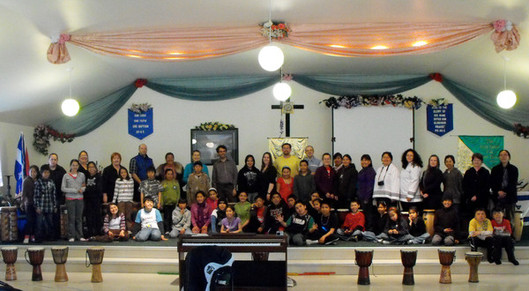
The project, which is called “Listen to the children: Connecting the North through story and song,” first took shape at the end of May in the course of a concert in Aupaluk, where pairs of students from each of the Nunavik communities joined together to perform their collective creation, a song called One Voice, One Song.
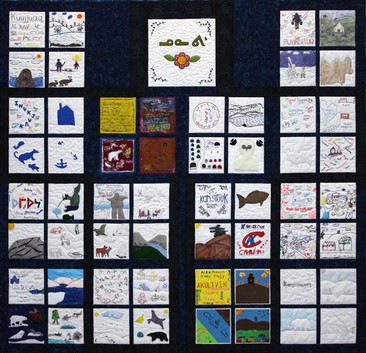
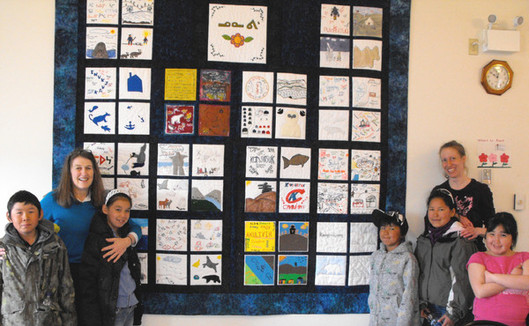
During the same event, a huge quilt designed by classes from all the communities was unveiled, along with a book that contained illustrated stories created by each of the groups of students.
All this began in the classroom of Sarah Russel, who teaches Primary 3, 4, 5 and 6 at Tarsakallak School in Aupaluk. Sarah wanted to help her students produce a group song, and so she called upon the skills of Debra Giebelhaus-Maloney, a multi-disciplinary artist, teacher and children’s lawyer to provide song-writing workshops for the students in Nunavik from her home in Calgary through the medium of Skype video-conferencing.
This was how a primary class from each of the Nunavik communities began receiving music instruction, twice monthly between October 2009 and May 2010, via video-conferencing.
Before long, a visual component was added to the production process. While the students worked on their song, they also created four scenes representing their class, community, land and local animals, which they embroidered onto fabric. The embroidered scenes were sewn together to create a giant quilt, an intercommunity work of art that will soon be displayed throughout the region.
Meanwhile, a book in 14 volumes, containing all the scenes the students embroidered accompanied by a story or local legend also written by the students, was printed for each class.
This remarkable project was made possible thanks to the financial support of several partners, particularly Makivik Corporation (the Ungaluk programme) Avataq Cultural Institute, New Paths for Education, Brighter Futures, Kativik Regional Government, Kativik School Board, Air Inuit, Nunalituqait Ikajuqatigiitut Inuit Association and Northern Affairs Canada, and of course the involvement of the community members of Aupaluk.